Carrier Fault Codes Explained in Encino
Straight talk: Carrier fault codes in Encino, CA range from Infinity comm faults 178 and 179 to furnace ignition flashes 14 and 34. Encino Carrier HVAC reads the code, confirms the failing part with a meter across 91316 and 91436, then quotes the real fix, so call (213) 755-3565 or book online.
Service snapshot
- Carrier fault-code diagnosis across Encino (91316, 91436).
- Infinity comm faults: 178 (indoor), 179 (outdoor) on the A-B-C-D bus.
- Condenser code 73: voltage at the cap, compressor no-start (24/25 families).
- Cooling code 44: excessive air-delivery restriction (airflow).
- Furnace flashes: 14 ignition lockout, 34 ignition proving, 31 pressure switch, 26 rollout.
- We confirm with a meter before condemning a part.
- Hours: Mon-Fri 7am-7pm, Sat 8am-4pm; emergency line after hours.
How do Carrier systems report a fault?
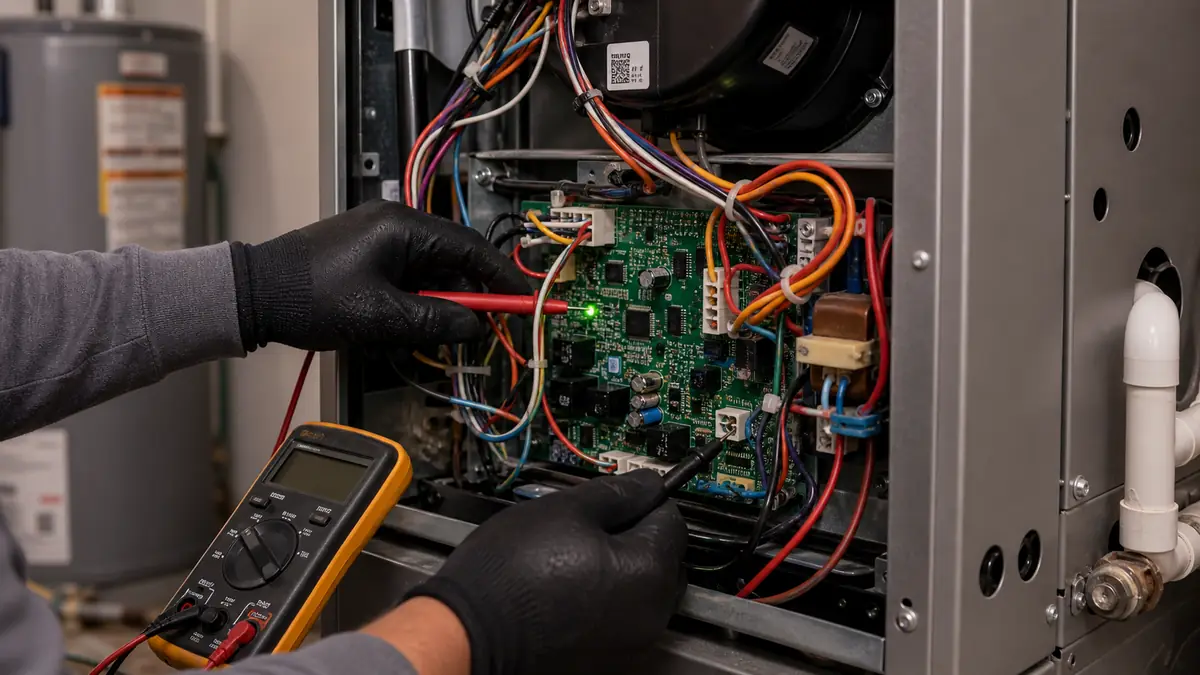
It depends on the equipment. A communicating Infinity system shows numeric and plain-language faults right on the touchscreen, which makes diagnosis faster. A non-communicating 59-series furnace flashes a status LED you count through the burner-door sight glass. A basic single-stage condenser has no display at all, so we diagnose it electrically with a clamp meter and a capacitor tester. Knowing which path your system uses is the first step.
What do the common codes mean?
Below are the Carrier codes we see most across Encino homes, with the likely cause and a typical repair lane. A code narrows the search; it does not replace measurement, so we still confirm before quoting.
| Code | Meaning / likely cause | Cost lane |
|---|---|---|
| 178 / 179 | Indoor / outdoor comm fault; A-B-C-D wiring or board | $150 - $2,000 |
| 73 | Voltage at cap, compressor no-start; capacitor | $150 - $450 |
| 44 | Excessive air-delivery restriction; filter/coil/ducts | $20 - $2,500 |
| 14 / 34 (furnace) | Ignition lockout / proving failure; igniter, flame sensor | $150 - $700 |
| 31 (furnace) | Pressure switch open; inducer, flue, condensate | $180 - $750 |
| 26 (furnace) | Rollout; inspect heat exchanger first | Inspect first |
How do we diagnose a comm fault like 178 or 179?
A communication fault is a wiring-and-board hunt, run in order. We start at the Infinity System Control and confirm it has power and is addressed correctly, then move to the four-wire A-B-C-D bus. We check voltage between the data lines and ground at both the indoor board and the outdoor board, looking for the break: a 179 outdoor fault often traces to a chewed wire in the attic, a corroded low-voltage terminal at the condenser, or water intrusion at the outdoor board after a wind-driven rain. A 178 indoor fault more often sits at the air-handler board or a loose plug. We wiggle-test terminals under a meter and isolate each board by substitution before condemning the expensive part, because a $15 terminal repair and a $900 board look identical on the screen.
What can I check myself before calling?
A few safe steps speed the visit. Note the exact code and any plain-language text on the Infinity touchscreen, and check whether the outdoor disconnect is pulled or a breaker has tripped, since a dead condenser reads as a comm fault. Replace a clogged filter, which clears many code 44 airflow flags on its own. Do not open the electrical compartment, do not jumper across a safety switch to force a furnace to run, and never reset a furnace repeatedly on a rollout or limit code. Those are combustion-safety devices, and bypassing them risks carbon monoxide. Anything involving the gas train, line voltage, or refrigerant is a tech job.
What do these code repairs cost in Encino?
The code points at the part, and the part sets the price. A code 73 no-start is usually a capacitor at $150 to $450. A furnace code 14 or 34 ignition fault is typically an igniter or flame sensor at $150 to $700. A code 31 pressure-switch fault runs about $180 to $750 once the inducer, flue, and condensate are checked. A comm fault (178/179) spans the widest lane, $150 to $2,000, depending on whether it is a wiring repair or a failed communicating board. A code 26 rollout is quoted only after a heat-exchanger inspection, because a cracked exchanger changes the conversation to replacement.
Deep dives on the furnace ignition codes
Two of the codes above come up often enough across Encino to warrant their own walkthrough. Code 14 is a hard ignition lockout after the furnace never proves flame; code 34 is the proving step itself failing on a cycle, where the burner lights and the flame sensor loses the signal. They usually trace to the same parts but call for slightly different checks. See Carrier code 14 (ignition lockout) and Carrier code 34 (ignition proving failure) for the full diagnostic and cost on each.
Which codes are safety issues?
Treat furnace code 26 (rollout) and any soot, gas smell, or repeated limit trips as combustion-safety matters, not nuisance faults. We inspect the heat exchanger and back-drafting before resetting anything. Comm faults like 178/179 are not safety issues but will leave a variable-speed system crippled until the wiring or board is fixed. The repair work lives on our furnace repair and Infinity control pages.
Common questions about Carrier fault codes in Encino
Where do I find the fault code on my Carrier system?
On a communicating Infinity system, the touchscreen lists numeric and plain-language faults under its menu. On a non-communicating furnace, watch the status LED flash through the burner-door sight glass and count the flashes. On a basic condenser there is no code; we diagnose electrically with a meter.
What do codes 178 and 179 mean on my Infinity screen?
They are communication faults: 178 is an indoor-unit comm fault and 179 is an outdoor-unit comm fault. Both point at the A-B-C-D communication wiring, a loose or corroded terminal, a chewed wire in the attic, or a water-damaged control board. We trace the four-wire run and test both boards.
Is a fault code always a big repair?
No. Plenty of codes resolve with an inexpensive part. A flame-sensor clean clears many code 34 furnace lockouts; a capacitor clears a code 73 no-start. We read the code, confirm the failing component with a meter, and quote the real fix before any work.
My furnace flashed code 26. What now?
Code 26 is a rollout switch trip, a combustion-safety fault. We stop and inspect the heat exchanger and burner area before doing anything else, because a cracked heat exchanger can release carbon monoxide. If it is compromised, we red-tag the furnace rather than reset it.
Can I clear a Carrier fault code by resetting power?
Sometimes the code clears, but the cause usually does not. Cutting power at the breaker resets a soft lockout like a one-time ignition fault, and the system may run again briefly. If it relocks within a cycle or two, the underlying part is failing and a reset just hides it. Never repeatedly reset a furnace that keeps locking out, especially on a rollout or limit code, since those are safety trips.
What does furnace code 31 mean on my Carrier system?
Code 31 is a pressure-switch fault: the switch did not close or reopened during the call for heat. The usual culprits are a failing inducer motor, a blocked or sagging condensate drain on a 59-series condensing furnace, a clogged flue, or the switch itself. We check inducer draft and the condensate trap before condemning the switch.