Carrier Code 14 Ignition Lockout in Encino, CA
Straight talk: A Carrier code 14 in Encino, CA (ZIP 91316 or 91436) is a hard ignition lockout: the furnace tried to light 3 times, never proved a steady flame, and shut the gas valve as a safety. Usually a worn igniter or dirty flame sensor is to blame, so call (213) 755-3565 or book online and we diagnose it.
Service snapshot
- Carrier code 14 (ignition lockout) diagnosis across Encino (91316, 91436).
- Most common causes: cracked hot-surface igniter, dirty flame sensor, no/weak gas.
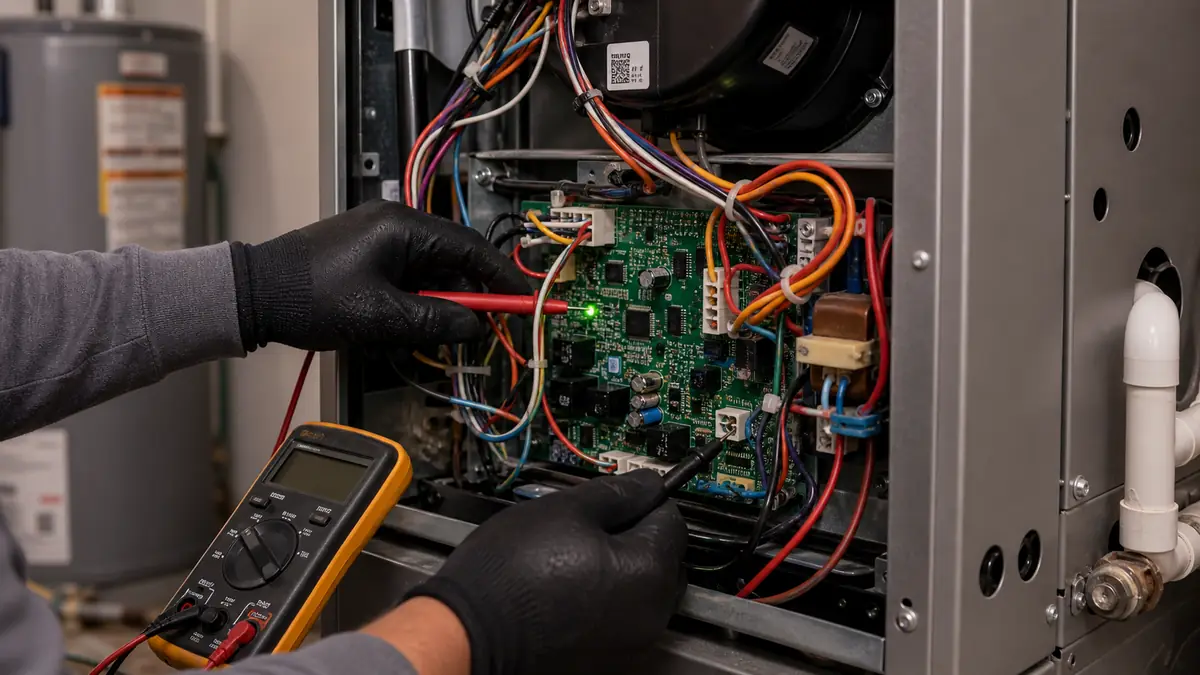
- We confirm flame-sense microamps and igniter resistance with a meter before quoting.
- Typical repair $150 - $400; gas valve or control board higher.
- Diagnostic roughly $89 - $200, credited toward an approved repair.
- Common on furnaces idle all summer in our mild Zone 9 valley.
- Hours: Mon-Fri 7am-7pm, Sat 8am-4pm; emergency line after hours.
What does code 14 mean on a Carrier furnace?
Code 14 is an ignition lockout. On a call for heat, a Carrier furnace runs a fixed sequence: the inducer proves draft, the hot-surface igniter glows, the gas valve opens, and the flame sensor must detect a flame within a few seconds. The control gives the burner three tries. If it never confirms a steady flame, it stops trying, shuts the gas valve, and flashes code 14 so raw gas cannot keep pouring into the heat exchanger. That last part matters: the lockout is the furnace protecting your home, not breaking. The fault tells you the furnace wanted to run and could not establish or hold a fire, which narrows the hunt to ignition and flame-sensing parts rather than the blower or the thermostat.
Why is my Carrier furnace ignition-locking in Encino?
Encino works against furnaces in a quiet way. Our Zone 9 valley climate against the Santa Monica Mountains means heat sits idle from roughly April to November, so a furnace in an Amestoy Estates ranch or a Royal Oaks single-story can sit untouched for seven or eight months. The first cold snap is when a flame sensor coated in a summer of oxidation finally reads too few microamps, or a hot-surface igniter that survived last winter cracks on its first hard cold start. On the sprawling single-story estates South of the Boulevard, the furnace often lives in a far closet or a hot attic platform, and a marginal igniter that worked when new gives up after years of thermal cycling. Add the dust that blows into Encino Hills closets over a dry summer, and a sooted flame sensor is the single most common code 14 we clear. None of that is random; it is the predictable wear pattern of a furnace that loafs all summer and then gets leaned on hard the first chilly week.
How do you diagnose a Carrier code 14?
We work the ignition sequence in the same order the furnace does, with instruments, so the failing part shows itself instead of getting guessed at. First we confirm the code and watch a full cycle through the burner-door sight glass: does the igniter glow, does the gas valve open, does flame appear and then drop out? Second we pull and inspect the hot-surface igniter and read its resistance with a meter; a healthy Carrier nitride igniter reads in the tens of ohms, while an open or badly out-of-spec one will not heat. Third, and most telling, we put a meter in series with the flame sensor and read flame-sense current in microamps while the burner is lit. A clean sensor reads several microamps; below roughly 1 to 2 the control calls it no flame and locks out. We clean the sensor with a non-abrasive pad and re-read. Fourth we verify gas: inlet and manifold pressure on a manometer, because a partly closed valve, a clogged orifice, or low supply pressure starves the flame so it lights and dies. Only after those readings do we look at the control board, since boards fail far less often than igniters and sensors. The meter, not the parts catalog, decides what gets replaced.
What can I safely check before calling a pro?
Two checks are safe and genuinely useful. Confirm the furnace switch is on and the gas is on at the meter and the appliance valve, since a furnace that was shut off for summer simply has no gas to light. Then cycle power once at the furnace switch or breaker to clear the lockout and watch one cycle; if it fires and runs cleanly, a one-time fault tripped it and you note that for us. Stop there. Do not pull the burner assembly, do not sand a flame sensor with the gas on, do not jumper the gas valve or the pressure switch, and do not reset the furnace over and over. Each failed try opens the gas valve, and forcing a furnace that will not prove flame can let unburned gas collect in the heat exchanger. If you smell gas at any point, leave the gas off and call from outside. Anything past a single reset, gas, line voltage, or the control board, is a tech job, and on a code 14 the flame-sense and gas-pressure readings need a meter you likely do not own.
What does a code 14 repair cost in Encino?
The price tracks the part the readings condemn. A flame-sensor clean or replacement is the cheapest and most common outcome, roughly $150 to $350. A hot-surface igniter runs about $150 to $400 installed depending on the furnace model and access in a tight Encino Village closet. Those two cover the large majority of code 14 calls. A gas-valve fault is higher, often $300 to $700, and a failed integrated control board lands around $400 to $900 installed, though boards are the least common cause. The diagnostic visit itself is roughly $89 to $200, frequently near $139, and we credit it toward an approved repair so the workup is not wasted money. We quote the real fix after the meter readings, not before, and we tell you which lane you are in once we know whether it is a sensor, an igniter, or something on the gas side.
When is a Carrier code 14 urgent?
Code 14 itself is the furnace failing safe, so a single lockout is not an emergency; you have no heat, but no immediate hazard. It becomes urgent in three cases. First, if you smell gas, treat it as an emergency: shut the gas, leave, and call from outside. Second, if the furnace relocks on code 14 repeatedly after resets, stop resetting, because each cycle dumps a little more unburned gas before the lockout. Third, on a cold snap with a vulnerable household, no heat is its own priority even though the fault is benign. Most Encino code 14 calls are next-day repairs once we confirm a sensor or igniter, and we keep those common parts on the truck. For the broader code picture, see our Carrier fault codes guide; for the repair itself, our furnace repair page.
Common questions about Carrier code 14 in Encino
What does Carrier code 14 mean?
Code 14 is a hard ignition lockout. The furnace tried to light the requested number of times (usually three), failed to prove flame each time, and shut the gas valve to keep raw gas from filling the heat exchanger. It is a safety stop, not a random glitch, and it stays locked until the cause is fixed or power is cycled.
Can I reset a Carrier code 14 myself?
You can cycle power once at the furnace switch or breaker to clear the lockout and confirm whether it lights. If it fires and runs, a one-time fault tripped it. If it relocks on code 14 within a cycle or two, stop resetting. Repeatedly forcing a furnace that will not prove flame can dump unburned gas, so let a tech find the cause.
How much does fixing a Carrier code 14 cost in Encino?
Most code 14 calls land between $150 and $400, because the usual fix is a cracked hot-surface igniter or a dirty flame sensor. A failed gas valve or control board runs higher. The diagnostic visit is roughly $89 to $200 and is credited toward an approved repair, so you are not paying twice.
Why does my Carrier furnace lock out on code 14 only on cold mornings?
A marginal igniter or weak flame sensor often lights fine in mild weather and fails on the coldest Encino mornings, when the furnace runs longest and the parts are most stressed. The cold start is when a hairline-cracked igniter finally stops glowing hot enough, or a sooted sensor drops below its microamp threshold. Intermittent cold-morning lockouts almost always mean a part on its way out.