Repair or Replace Your AC in Encino, CA
Last updated: 2026-06-13
Straight talk: The repair-or-replace call on an Encino, CA Carrier AC comes down to three quick gut-checks: is the condenser already 10 to 12 years old, does the fix run past half the price of a fresh system, and does age multiplied by repair cost clear roughly $5,000. For 91316 and 91436 homes, Encino Carrier HVAC puts the repair quote and the replacement quote side by side so you choose on numbers. Call (213) 755-3565 or book online.
Service snapshot
- Independent repair-or-replace guidance for Carrier systems across Encino (91316, 91436).
- Carrier condensers typically last 12 to 16 years in Encino's Zone 9 heat.
- Repair bands: capacitor $150 - $450; compressor $1,200 - $3,500; coil leak $225 - $1,500.
- Replace bands: central AC $5,000 - $12,000; ducted heat pump $6,000 - $16,000.
- Split ACs under 45k BTU must hit the Southwest floor of 14.3 SEER2 / 11.7 EER2.
- No federal 25C credit on a 2026 install; the program closed after 12/31/2025. Confirm LADWP, SCE, and SoCalGas amounts yourself.
- R-410A is phasing down; new equipment moving to R-454B.
- Hours: Mon-Fri 7am-7pm, Sat 8am-4pm; emergency line after hours.
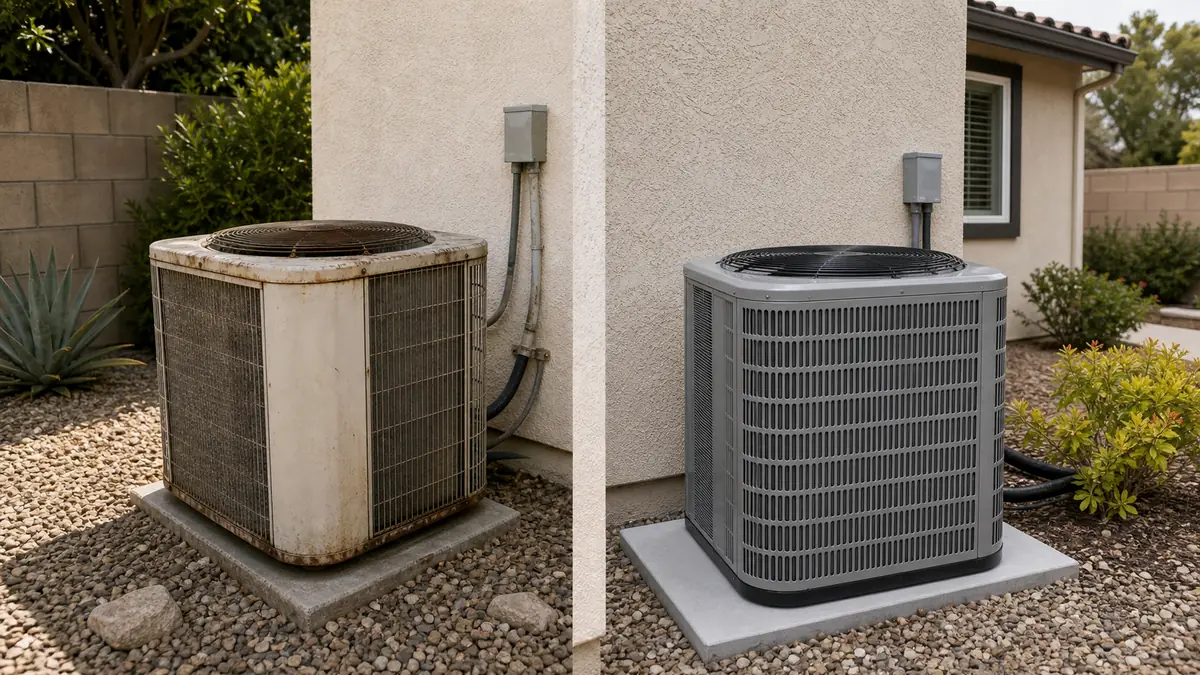
What are the three rules that settle most decisions?
Across Encino, three checks resolve nearly every call. Start with age: a Carrier condenser tends to give 12 to 16 years in this valley heat, so once it passes 12 you look hard at any repair worth more than pocket change. Next is the 50-percent test: if one repair bill tops half the cost of an equivalent new Carrier system and the unit is already living past its useful years, the replacement tends to win. Last is the age-times-cost screen, where you multiply the years on the unit by the repair price; the moment that figure passes about $5,000, you are propping up a system living on borrowed time. None of the three is a strict rule, yet stacked together they cut straight through the sales noise.
Three worked examples from Encino homes
The rules are easier to trust with numbers behind them. Take three common Encino situations and run them through the same screens.
Example one: the clear repair. A 6-year-old Infinity 24VNA6 south of Ventura quits cooling and the run capacitor reads 18 microfarads against a 45 rating. The fix is about $300. Age times cost is 6 times $300, or $1,800, nowhere near the $5,000 line, and the repair is a fraction of one percent of a replacement. Fix it without a second thought; this system has a decade of life left.
Example two: the clear replace. A 15-year-old Performance 16 on an Amestoy ranch loses its compressor, and the quote to swap it is $2,900. Age times cost is 15 times $2,900, far past $5,000, and the repair is roughly half the price of a $5,500 like-for-like changeout on a unit already at the end of its R-410A life. Replace it; pouring $2,900 into a 15-year-old platform buys maybe two more years.
Example three: the judgment call. An 11-year-old Performance 18 needs a $1,400 leak repair plus recharge. Age times cost is 11 times $1,400, about $15,400, well over the line, yet $1,400 is only a quarter of a new system. Here we weigh the refrigerant: it is R-410A, the coil has leaked once, and an 11-year-old unit is statistically near the back half of its life, so we lay out both quotes and most owners lean replace. None of this is automatic, which is exactly why we measure and quote both paths.
What does a tech inspect before giving the verdict?
A real repair-or-replace verdict comes off measurements, not a glance at the data plate. We read the run capacitor in microfarads, clamp compressor and condenser-fan amperage against the nameplate, and check refrigerant superheat and subcool to judge charge and metering. We read total external static pressure to flag a duct or airflow problem masquerading as an equipment problem, and we inspect the coil and the compressor terminals for signs of impending failure. We pull the data plate to confirm age, refrigerant type, and original capacity, and on a communicating Infinity system we read stored fault history off the touchscreen. Only with those numbers in hand do we put a repair price and a replacement price side by side, because half the calls we get for a quote on a new system turn out to need a few-hundred-dollar fix instead.
What does a repair actually cost in 2026?
Repair cost depends entirely on the failed part, and the spread is wide. A capacitor is a same-day, few-hundred-dollar fix; a compressor or a major refrigerant leak is in a different league. The table below shows typical 2026 SoCal ranges so you can place your quote in context.
| Repair | What failed | Typical range |
|---|---|---|
| Capacitor / contactor | Most common no-cool electrical fix | $150 - $450 |
| Condenser fan motor | Bearing or motor failure | $300 - $900 |
| Refrigerant leak + recharge | Leak search plus R-410A | $225 - $1,500 |
| ECM blower motor / module | Variable-speed indoor blower | $450 - $2,300 |
| Infinity / inverter control board | Communicating or inverter board | $400 - $2,000 |
| Compressor | Greenspeed or single-stage compressor | $1,200 - $3,500 |
What does replacement cost, and what do you get?
Replacement buys efficiency, a fresh warranty, and current refrigerant, but it is a bigger check. A like-for-like central AC changeout is the floor; a high-efficiency variable-speed heat pump on a large Encino estate is the ceiling. The table frames the lanes.
| New system | Best for | Installed range |
|---|---|---|
| Central AC (condenser + coil) | Keeping gas heat, like-for-like | $5,000 - $12,000 |
| Ducted heat pump | Heat and cool, all-electric option | $6,000 - $16,000 |
| Gas furnace replacement | 59-series, often paired with AC | $3,000 - $7,500 |
| Ductwork (replace/new) | Pairing with a changeout | $1,900 - $6,000 |
How does Encino's climate weigh on the math?
Tucked against the Santa Monica Mountains, Encino falls into Title-24 Climate Zone 9, where the air stalls on hot afternoons and 50 to 70 days each year top 90 F. A cooling season that long and that punishing pulls the decision two ways. It wears equipment out sooner, so a 13-year-old condenser here has effectively lived longer than the identical unit cooling a mild beach town. It also stretches the efficiency payback, since a high-efficiency system clocks far more cooling hours in Zone 9 than it ever would in Zone 8. Spread that math over a sprawling estate south of the Boulevard and the hours pile up fast.
What about refrigerant and the R-410A phase-down?
Older Carrier systems run R-410A, which is being phased down under federal rules, while new equipment is moving to lower-GWP refrigerants such as R-454B. Practically, that means a large refrigerant repair on an aging R-410A unit is a weaker long-term investment than it once was, because you are putting money into a platform on its way out. It is not a reason to panic-replace a healthy system, but it does nudge genuinely borderline cases toward replacement.
What rebates can I actually count on in 2026?
Bad rebate information is everywhere, so here is the straight version. Section 25C, the federal Energy Efficient Home Improvement Credit that paid 30 percent up to $2,000 toward a heat pump, was repealed as of December 31, 2025; the 2025 return can only count gear that was purchased and installed on or before that day, which leaves a 2026 Encino install with nothing to claim federally. The local route may still pay off: LADWP has run a tiered heat-pump rebate, SCE a per-system one, and SoCalGas an incentive on furnaces and smart thermostats. That said, a number of California programs, the statewide TECH single-family pool among them, were reported fully reserved or on pause early in 2026. Before you fold any of it into a budget, confirm the live amount and the funding status straight from the program.
| Program | Reported help | Status caveat |
|---|---|---|
| Federal 25C credit | Was 30% up to $2,000 (heat pumps) | Expired 12/31/2025; not for 2026 |
| LADWP heat-pump rebate | Tiered, per-ton by efficiency | Verify amount and effective date |
| SCE heat-pump rebate | Reported ~$1,000 per system | Verify current amount/status |
| SoCalGas furnace / thermostat | Reported up to ~$600 / ~$50 | Changes by program year |
When is repair clearly the right call?
Repair wins when the system is under about 10 years old, the failed part is inexpensive (capacitor, contactor, igniter, flame sensor), and the rest of the system tests healthy on charge and airflow. It is also the right first move when the real complaint is comfort, not equipment: fixing leaky ducts or adding a properly sized return can solve uneven cooling for a fraction of a replacement, as our duct repair page explains. And if your unit is still inside Carrier's warranty, take it to a factory-authorized dealer first so a covered part stays covered.
Common questions about repair versus replace in Encino
At what age should I stop repairing a Carrier AC in Encino?
Most Carrier condensers run 12 to 16 years in Encino's heat. Past 12 years, weigh any repair over a few hundred dollars against replacement, and past 15 years lean replace for anything major. The clincher is the part: a capacitor at 14 years is still worth fixing; a compressor is not.
Is the 50-percent rule real or just a sales pitch?
Treat it as a working guideline rather than a hard law. The moment one repair would cost you north of half what a comparable new Carrier system runs, and the equipment has already aged past its useful life, the replacement usually wins on paper. We set the real repair quote beside the real replacement quote so the Encino homeowner decides on numbers, not on a sales push.
Does R-410A phase-out change my decision?
It can. Older systems use R-410A, which is being phased down, and newer equipment uses lower-GWP refrigerants like R-454B. A major leak repair on an aging R-410A unit is a weaker investment than it was a few years ago, which nudges borderline cases toward replacement.
Will a new system really lower my Encino bill enough to matter?
Over a long Zone 9 cooling season, yes, the efficiency gap is real, especially replacing an old low-SEER2 single-stage unit with a variable-speed Carrier Infinity. But do not let a salesperson promise an exact dollar figure; savings depend on your ducts, insulation, and thermostat habits.
Should I fix ducts before deciding on a new condenser?
Often, yes. If leaky ducts or an undersized return are the real complaint, a duct repair can solve the comfort issue for far less than a new system, and it makes whatever equipment you keep run better. We check airflow before recommending a replacement.
Is it worth replacing just the condenser and keeping my old coil?
Rarely a good idea. A new outdoor unit paired with an old indoor coil often mismatches capacity and metering, voids the new equipment warranty, and on R-410A versus newer refrigerants may not be compatible at all. We almost always replace the condenser and matching coil together so the system is rated as a set and the warranty holds.
My Carrier is 9 years old and needs an $1,800 repair. Repair or replace?
This is the classic borderline case. At 9 years the unit is under its expected 12-to-16-year life, but $1,800 is a real chunk of a replacement. Run the age-times-cost screen: 9 years times $1,800 is well past the rough $5,000 line, which leans replace. The deciding factor is what failed. A board or motor is worth fixing at 9 years; a compressor on an R-410A unit is not.