Air Duct Repair and Sealing in Encino, CA
Straight talk: Encino Carrier HVAC repairs and seals ductwork across Encino, CA, from Amestoy Estates to the 91316 ranch flats, fixing leaky attic runs, undersized returns, and crushed flex, then HERS-verifying the result so your Carrier system delivers full airflow; call us at (213) 755-3565 or book online. Duct repair and sealing typically runs $1,900 to $6,000.
Service snapshot
- Duct repair, sealing, and return upgrades across Encino (91316, 91436).
- Focus: ranch-era attic ducts, undersized returns, crushed flex, register balancing.
- Diagnostics: room-by-room static pressure and airflow, not guesswork.
- Duct repair/replacement typically $1,900 - $6,000 depending on scope.
- HERS duct-leakage verification coordinated on qualifying jobs.
- Often paired with a Carrier coil or condenser service for one trip.
- Hours: Mon-Fri 7am-7pm, Sat 8am-4pm; emergency line after hours.
Why do Encino ducts leak so much?
Most Encino single-story homes hide their ducts in a vented attic that hits 130 F or more on a Zone 9 afternoon. Decades of tape failures, disconnected boots, and rodent damage turn those runs into leaks that dump conditioned air into the attic instead of the bedrooms. A long ranch floor plan makes it worse: the trunk loses pressure before it reaches the far wing, so the master suite never cools while the hallway is freezing. The fix is sealing and rebalancing, not a bigger condenser.
How do you find and fix the bad spots, step by step?
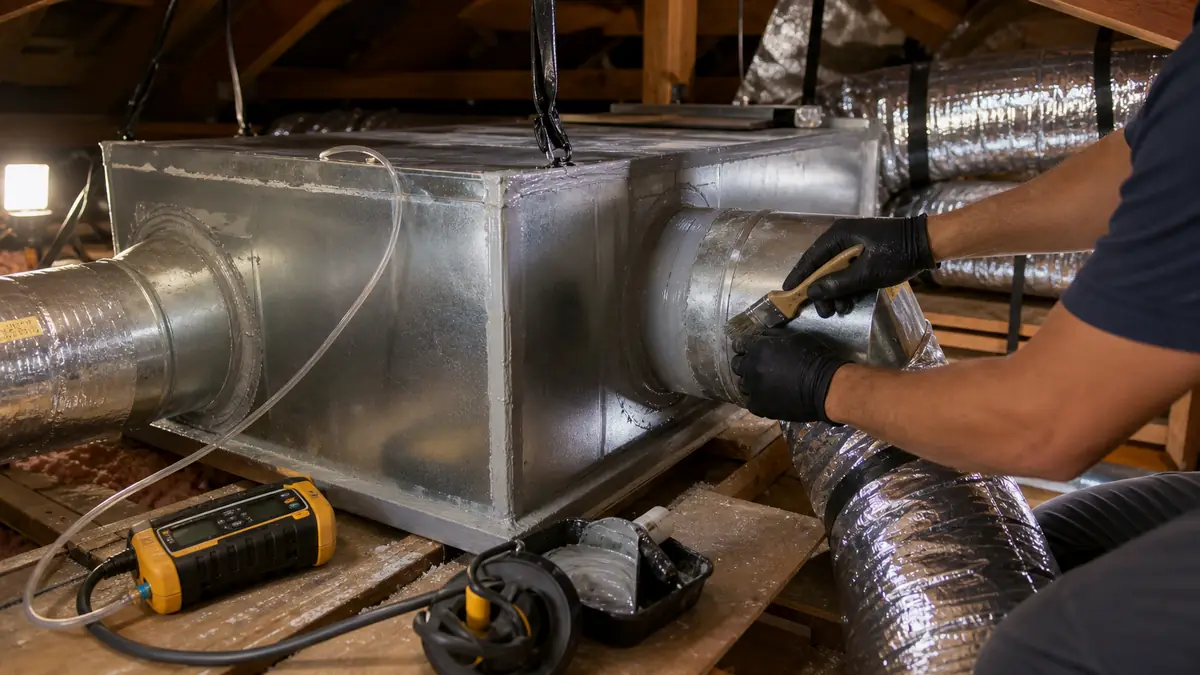
The job follows a measure-first order. First we read total external static pressure at the air handler with a manometer; a reading above roughly 0.8 inches of water column flags a restriction, usually an undersized return choking your Carrier ECM blower. Second we check airflow at each supply register and feel for return starvation. Third we walk the attic, inspecting boots, joints, and flex supports for the failed tape, pulled-apart connections, and rodent damage common in Encino's vented attics. Fourth we seal the joints with mastic (not the failing cloth tape), re-support sagging flex to the right radius, and add or enlarge returns where static demands it. Fifth, on a qualifying job, an independent HERS rater runs a calibrated duct-leakage test so the permit closes. We re-read static and register airflow at the end to prove the balance changed.
| Finding | Fix | Cost lane |
|---|---|---|
| High static, weak airflow everywhere | Add or enlarge return; reduce restriction | $400 - $2,500 |
| One wing hot, leaks at boots/joints | Reseal and re-support attic runs | $800 - $3,000 |
| Crushed or collapsed flex run | Replace and properly support the run | $300 - $1,200 |
| Failed/disconnected duct, attic dumping | Reconnect and seal; HERS verify | $500 - $2,500 |
| Brittle, undersized whole system | Full duct replacement, sized to the load | $1,900 - $6,000 |
| Code 44 on Carrier, iced coil | Clear restriction, resize return/filter | $400 - $2,000 |
What does duct work cost in Encino, and why?
A targeted repair starts a few hundred dollars; a full duct replacement on a sprawling single-story runs toward $6,000. The drivers are scope, access, and verification. A reseal-and-re-support job is mostly labor in a hot attic. Adding or resizing a return means cutting drywall and fabricating a new grille and run. A full replacement on a 2,500-square-foot ranch involves new trunk, branches, boots, and balancing dampers, sized to the Manual J airflow rather than copied from the old layout. Then a 130 F summer attic and a hillside 91436 crawlspace add labor time, and the HERS leakage test adds the rater's fee. We itemize sealing, returns, replacement footage, and verification so the quote is legible.
Does this help my Carrier system last longer?
Yes. A choked return raises static pressure on the ECM blower and can ice the indoor coil or trip code 44 (excessive air-delivery restriction) on a Carrier system. Fixing the ducts lowers the strain on the blower motor, lets the refrigerant cycle work as designed, and keeps the compressor from short-cycling. It is one of the cheapest ways to extend equipment life in Encino's heat. See our weak-airflow troubleshooting page for the symptom side.
What about Title-24 on duct work?
Inside Climate Zone 9, replacing or heavily reworking ductwork usually calls for HERS field verification of duct leakage, while a coil or condenser changeout carries its own charge and airflow verification. We pull the permit and book the rater so the job closes legally, and that paper trail also covers you at resale when an inspector asks to see it.
What makes Encino ductwork its own problem?
The mid-century ranch belt around Encino Village and Lake Encino was built for smaller cooling loads than today's homes carry, often with one undersized central return and long single-trunk runs feeding a sprawling single-story footprint. Decades later those runs hide in a vented attic that bakes past 130 F on a Zone 9 afternoon, so failed cloth tape, pulled-apart boots, and rodent-chewed flex are the norm, not the exception. When a 1960s ranch gets opened into a 4,000-square-foot floor plan, the original ducts simply cannot reach the far wing, which is why the new owners call about a hot master suite even though the condenser is fine. Hillside 91436 homes add their own twist with cramped attics and crawlspaces that slow the work. Sealing and resizing those ducts, then HERS-verifying the result, recovers comfort and cuts the SCE bill far more reliably than oversizing the Carrier equipment ever would.
Common questions about Encino duct repair
Why are some Encino rooms hot when the AC runs fine?
Uneven rooms usually mean duct problems, not a bad condenser. Disconnected attic runs, crushed flex, and undersized returns starve the far end of a long ranch floor plan. We measure static pressure and airflow per room, then reseal, re-support, or resize the trunk and returns to balance the home.
Does duct sealing in Encino need HERS verification?
Once we alter or replace a meaningful share of your ductwork in Title-24 Climate Zone 9, a HERS rater normally has to field-verify the duct leakage. We bring in that independent rater and aim for the code leakage threshold so your permit closes without a snag.
Will sealing ducts lower my summer electric bill?
Often, yes. Ranch-era ducts in a 130 F Encino attic can leak 20 to 30 percent of conditioned air into the attic. Sealing those leaks means your Carrier system delivers more of what it makes to the rooms, so it runs shorter cycles and the SCE bill drops.
Can you keep my existing Carrier system and just fix the ducts?
Yes, and that is often the smart first move. Before anyone sells you a bigger condenser, a duct repair and a proper return upgrade may solve the comfort complaint for a fraction of a system replacement, while making your current Carrier unit last longer.
How do you measure whether my ducts are actually leaking?
We read total external static pressure at the air handler with a manometer, then check airflow at each register, and on a qualifying job a HERS rater runs a duct-leakage test with a calibrated fan. Numbers, not guesses: high static with low register flow tells us where the trunk loses pressure and where the returns choke the Carrier blower.
Will new ducts make my smaller Carrier system enough?
Often, yes. A right-sized Comfort or Performance condenser that seemed too small was usually fighting leaky ducts and starved returns. Once we seal the runs and open up the return path, the rated airflow reaches the rooms and the home cools evenly, so you avoid paying for oversized equipment that would only short-cycle in Encino's heat.
Can you add a return to a 1960s Encino ranch?
Usually yes, and it is one of the highest-value moves on older ranch stock. Many mid-century Encino homes ran a single undersized central return that starves a modern ECM blower. We add or enlarge a return in a hallway or central wall, which drops static pressure, quiets the system, and lets the coil and refrigerant cycle work as Carrier designed them.