HVAC Sizing and Manual J in Encino, CA
Last updated: 2026-06-13
Straight talk: Sizing an Encino, CA system correctly starts with a Manual J load calculation, never a square-foot shortcut or a copy of whatever tonnage was bolted down before. Encino Carrier HVAC matches Carrier equipment to the home's real load across 91316 and 91436 and carries Title-24 HERS verification to closeout, so call (213) 755-3565 or book online.
Service snapshot
- Every Carrier install across Encino (91316, 91436) sized by Manual J load calc.
- Encino falls in Title-24 Climate Zone 9; design days bake against the mountains.
- The square-feet-per-ton shortcut habitually oversizes Encino homes, so we skip it.
- Go too big and you invite short-cycling, weak dehumidification, and a worn compressor.
- Changeouts generally need a HERS rater to field-verify charge and airflow.
- Duct sealing verification required when ducts are altered.
- Large estates often run two right-sized systems or one zoned Infinity.
- Hours: Mon-Fri 7am-7pm, Sat 8am-4pm; emergency line after hours.
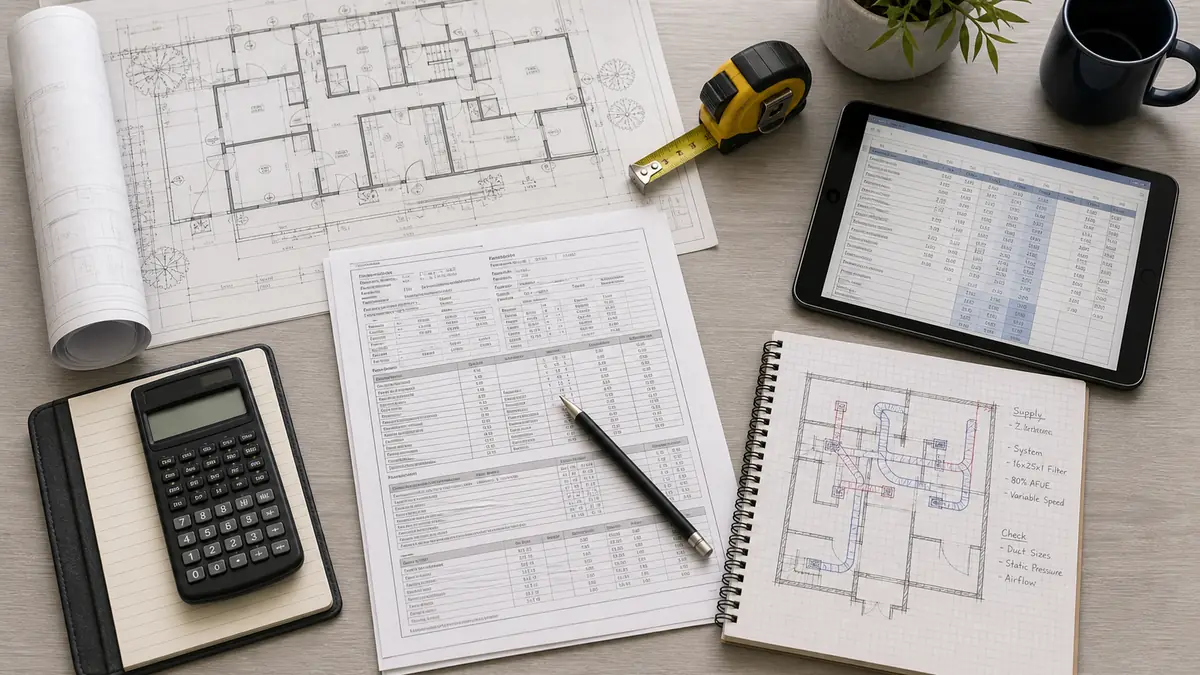
Why do rules of thumb fail Encino homes?
The old shortcut, one ton of cooling per 400 to 600 square feet, ignores everything that actually drives load. Two Encino homes of identical size can have very different loads depending on west-facing glass, attic insulation, air leakage, and shade. The teardown-and-rebuild wave makes it worse: a 1960s ranch reopened into a 4,500-square-foot great room with walls of glass has nothing in common, load-wise, with the original house. Sizing by square footage in Encino almost always lands too big, and oversizing is its own problem.
What goes wrong when a system is oversized?
An oversized condenser chills the air around the thermostat in a hurry, then cuts out before it has stripped humidity or balanced the distant rooms. Those clipped runs are short-cycling, and the constant restarts batter the compressor harder than anything else can, while the house stays damp and uneven. Encino's heat rewards a system that holds a long, low, steady cycle, which is exactly the rhythm a right-sized unit keeps, a variable-speed Carrier Infinity most of all. Extra capacity is no safety cushion; it is a tax on both comfort and reliability.
Square-foot rule versus Manual J: a worked contrast
Run the same Encino home both ways and the gap is obvious. Take a 2,400-square-foot 1961 ranch near Encino Village that has since been re-windowed with dual-pane low-E glass, had R-38 blown into the attic, and gained afternoon shade from mature trees on the west side. The old 1-ton-per-500-square-feet shortcut calls for nearly 5 tons. A Manual J that actually credits the better glass, the deeper insulation, the tighter envelope, and the real shade books a sensible cooling load closer to 38,000 to 42,000 BTU, which is 3 to 3.5 tons. That is up to a ton and a half of phantom capacity the shortcut would have bolted to the slab, and every bit of it works against comfort and the compressor.
The contrast flips on a glassy rebuild. A 4,500-square-foot teardown reopened into a great room with two walls of west-facing glass can demand more cooling per square foot than the shortcut assumes, because the solar gain through all that unshaded glazing dwarfs the floor area. Either way, the square-foot rule is wrong; it just happens to be wrong in opposite directions on the two homes Encino is full of. Only a load calc that weighs the actual glass, insulation, and orientation lands the real number.
The oversizing failure chain, step by step
Going big on an Encino system does not buy headroom; it kicks off a cascade that gets worse with every cycle. Step one, the too-large condenser satisfies the thermostat in a short burst, often five to eight minutes, because it dumps capacity fast. Step two, it cuts off before it has run long enough to pull humidity out of the air, so a damp, clammy house develops even at the set temperature. Step three, the clipped cycle never lets the distant rooms catch up, so the far bedrooms on a long ranch stay warm while the hallway by the thermostat is cold. Step four, the constant stop-start, called short-cycling, hammers the compressor with inrush current on every restart and wears it out years early. Step five, the wasted starts and the never-reached steady state push the energy bill up rather than down. A right-sized unit, by contrast, runs longer, lower, steadier cycles that dehumidify, balance the rooms, and protect the compressor, and a variable-speed Carrier Infinity takes that further by modulating down instead of cycling off at all.
What does a Manual J calculate?
The Manual J residential load calculation is the method the trade treats as standard. It books the heat gained and lost in each room and then for the house as a whole. The table below walks the chief inputs and what each one means under Encino conditions.
| Input | Why it matters in Encino |
|---|---|
| Window area and orientation | West and south glass drives big afternoon gain in the valley heat |
| Insulation levels | Older ranch attics often under-insulated; rebuilds vary widely |
| Air leakage | Leaky envelopes raise load; tight rebuilds lower it |
| Design temperature | Uses a hot Zone 9 design day, not a mild coastal one |
| Internal gains | Occupants, appliances, and lighting add measurable load |
| Ceiling height / volume | Vaulted great rooms in rebuilds change the math |
How does the load become a Carrier tonnage?
Once the Manual J gives the cooling load in BTU, we translate it to nominal tons (12,000 BTU per ton) and pick the Carrier equipment that matches, then sanity-check airflow and duct capacity. A variable-speed Infinity 25VNA4 has a wide modulation range, so it forgives a slightly off-target load better than a single-stage unit, but we still aim for the right base size. The table shows the rough mapping; your actual number comes from the calc, not the chart.
| Cooling load | Nominal tons | Typical Carrier fit |
|---|---|---|
| ~24,000 BTU | 2 tons | Comfort / Performance, smaller ranch |
| ~36,000 BTU | 3 tons | Performance, typical mid-century home |
| ~48,000 BTU | 4 tons | Infinity or zoned, larger estate |
| ~60,000 BTU | 5 tons | Often split into two systems |
What does Title-24 require on a new system?
Title-24, Part 6 is California's energy code, and it sorts HVAC changeouts across 16 climate zones keyed to reference weather stations, which means a single city can straddle more than one; Encino lands in cooling-dominant Zone 9. On the ground, swapping a split system here usually pulls a permit alongside HERS field verification of refrigerant charge and airflow, with duct-sealing verification added whenever we open the ducts. For the Southwest region, the federal SEER2 floors run 14.3 SEER2 / 11.7 EER2 on split ACs below 45,000 BTU and 14.3 SEER2 / 7.5 HSPF2 on split heat pumps. Because the code cycle and its triggers shift, we nail down the precise current rule for your address and equipment class before the job.
When should a big Encino home be zoned or split?
A long single-story estate or a multi-wing rebuild rarely heats and cools evenly from one central unit. Two options solve it: two right-sized Carrier systems, each handling part of the home, or one zoned variable-speed Infinity system with dampers and the Infinity System Control coordinating the zones. A room-by-room load tells us which makes sense. Our installation page covers the build, and the Infinity control page explains the zoning brain.
The choice usually turns on layout and duct geometry. Two independent systems give each wing its own redundancy, so a failure on one side still leaves half the house cooled, and they suit homes where the wings are far apart or on different levels. A single zoned Infinity system costs less to install where the ducts already converge on one air handler, and its variable-speed compressor modulates cleanly as zones open and close. We size each zone's load separately either way, because a zoned system still oversizes badly if the base capacity is wrong.
Common questions about HVAC sizing in Encino
Why not just match the tonnage of my old Encino unit?
Because the old unit was often guessed at, and your home has likely changed: new windows, added insulation, a rebuilt floor plan, or a different shading situation. Copying the old size repeats the old mistake. A Manual J calculates the actual load today, which frequently lands a different tonnage than the unit you are replacing.
Is bigger safer for an Encino heat wave?
No, going large works against you. An oversized condenser hits the thermostat setpoint in quick bursts, quits before it has wrung out humidity or balanced the far rooms, and short-cycles the compressor into an early grave. A right-sized unit holds longer, steadier cycles, which is precisely the behavior you want on a 95 F afternoon.
What does a Manual J actually measure?
It weighs square footage, ceiling height, glass area and orientation, insulation, air leakage, the local design temperature, and the heat thrown off inside the home. Here it runs against a hot Zone 9 design day. What lands at the end is the home's true heating and cooling load in BTU, which we then convert to Carrier tonnage.
Does a new system in Encino require HERS testing?
Usually it does. Inside Title-24 Climate Zone 9, swapping a split system normally calls for a HERS rater to field-verify refrigerant charge and airflow, plus duct-sealing verification whenever the ducts get touched. Pulling the permit and booking that independent rater is part of how we run the job.
Can a big estate use one system or does it need zoning?
It depends on the load and layout. A long single-story estate often performs better as two right-sized Carrier systems or one zoned variable-speed Infinity system than as a single oversized condenser. The Manual J and a room-by-room load tell us which approach fits.
How much smaller is a right-sized unit than the square-foot guess?
Often a full ton smaller on an Encino home. A 2,400-square-foot ranch by the old 1-ton-per-500-square-feet rule reads as nearly 5 tons, while a Manual J that credits new windows, added insulation, and real shade frequently lands near 3 to 3.5 tons. That gap is exactly why the shortcut oversizes and why we run the calc.
Does a variable-speed Infinity let you skip the load calc?
No. A variable-speed Infinity 25VNA4 modulates across a wide range, so it tolerates a slightly off-target load better than a single-stage unit, but it still has a maximum and minimum capacity. Oversize even a modulating system badly and it spends hot afternoons pinned at full output while still short-cycling on mild days. We size the base capacity correctly and let modulation handle the rest.
Will a right-sized system actually keep my house cool on the hottest day?
Yes, that is the point of using a real design temperature. Manual J sizes to a hot Zone 9 design day, not the single worst hour of the decade, so a correctly sized unit holds setpoint through a normal 95 F Encino afternoon with margin to spare. Oversizing for the rare extreme just makes the system worse the other 99 percent of the season.