Carrier Furnace Repair in Encino, CA
Straight talk: Encino Carrier HVAC repairs Carrier gas furnaces across Encino, CA, from Encino Village to the 91436 hillsides, clearing 59-series ignition lockouts, diagnosing code 13/14/31/34 faults, and replacing flame sensors, igniters, and inducers; call us at (213) 755-3565 or book online. The diagnostic runs near $139 and is credited to an approved repair.
Service snapshot
- Carrier furnace repair across Encino (91316, 91436) and the surrounding tracts.
- Lines serviced: Infinity 59MN7/59TN6, Performance 59TP6, Comfort 59SC6, 58-series 80 percent.
- Common parts: hot-surface igniter, flame sensor, inducer, pressure switch, gas valve, control board.
- Diagnostic roughly $89 - $200; flame-sensor or igniter fixes usually $150 - $650.
- Furnace replacement typically $3,000 - $7,500; CA Ultra-Low NOx models common here.
- Hours: Mon-Fri 7am-7pm, Sat 8am-4pm; emergency line after hours.
- In-warranty heat exchangers go to factory-authorized service first.
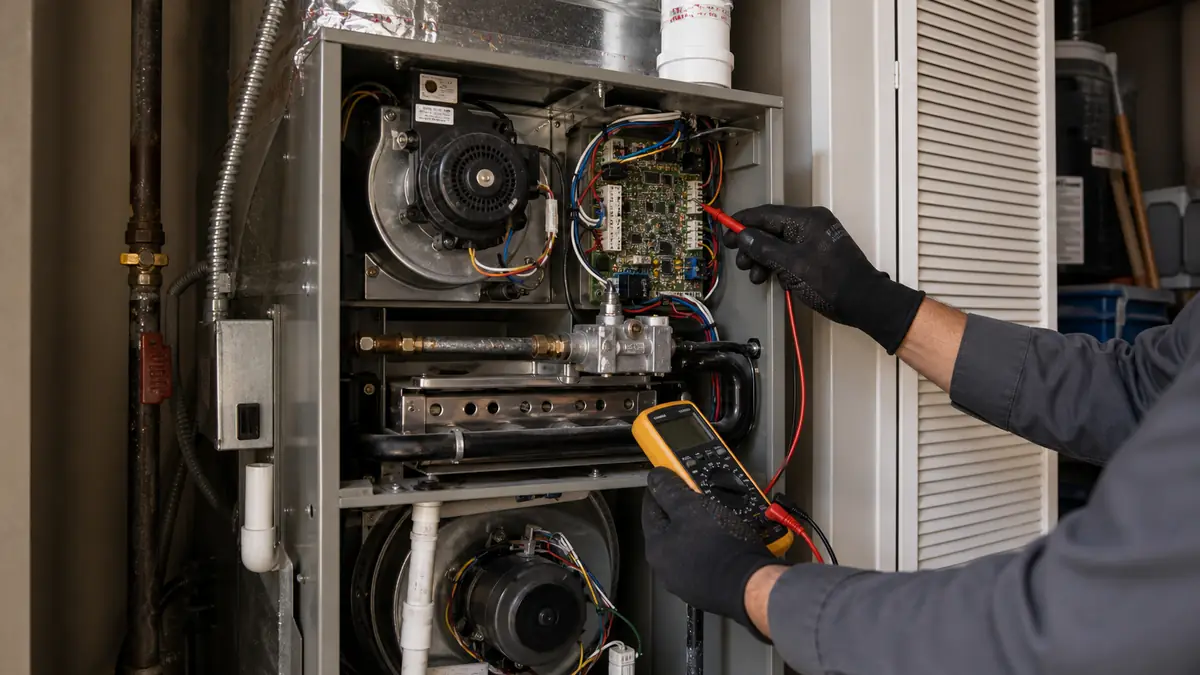
What fails most on a Carrier furnace here?
The ignition train causes most no-heat calls. A hot-surface igniter cracks, a flame sensor crusts over and stops proving flame, or an inducer and pressure switch fall out of sync so the board never starts ignition. On Carrier 59-series boards these show as flash codes: 14 for a hard ignition lockout, 34 for ignition proving failure, 31 for a pressure switch that did not close. We read the code, then confirm the failing part with a meter rather than swapping parts on a hunch.
How do you diagnose a no-heat call, step by step?
On an Encino no-heat call we trace the ignition train link by link, in the order it actually fires, so the verdict names the broken component instead of the symptom on the surface. First we read the 59-series flash code through the burner-door sight glass and check the stored history on an Infinity touchscreen. Second we watch a full ignition sequence: the inducer should spin up, the pressure switch should close, the hot-surface igniter should glow, the gas valve should open, and the flame sensor should prove flame within a few seconds. Third we meter the part that drops out, a flame-sensor microamp signal under one microamp is a dirty or failing sensor, an open pressure switch with the inducer running points at a blocked flue or condensate trap, and a cracked igniter reads open ohms. Fourth, on any rollout (code 26) or limit trip, we inspect the heat exchanger and check for back-drafting before we re-light anything.
How do you read a 59-series flash code?
Carrier furnaces flash a status LED you can see through the sight glass on the burner door, counting short flashes for the first digit and long flashes for the second. The table below maps the codes we see most in Encino to their likely cause and a typical repair lane. Code 26 (rollout) always triggers a heat-exchanger inspection before any other work.
| Flash code | Meaning / first check | Cost lane |
|---|---|---|
| 14 | Hard ignition lockout; igniter or flame sensor | $150 - $650 |
| 34 | Ignition proving failure; flame sensor, gas valve | $150 - $700 |
| 31 | Pressure switch open; inducer, blocked flue/condensate | $180 - $750 |
| 13 / 33 | Limit circuit lockout/fault; airflow, dirty filter | $120 - $600 |
| 24 | Control fuse open; shorted accessory or wiring | $120 - $400 |
| 45 | Control circuitry lockout; control board fault | $300 - $900 |
| 26 | Rollout switch; inspect heat exchanger | Inspect first |
Which Carrier furnace lines do you repair?
We service the whole 59-series condensing range and the 58-series 80-percent furnaces still in older Encino homes. The flagship Infinity 59MN7 (about 98 AFUE) pairs a modulating gas valve with a variable-speed ECM blower, so its repairs can involve the modulating valve, the ECM module, or the communicating board. The two-stage 59TN6 and 59TN7 (Infinity 96/97) and the Performance 59TP6 share the same ignition train but use simpler staging. The single-stage Comfort 59SC6 (96 AFUE) and the 59CU5 Ultra-Low NOx model are the straightforward workhorses where igniter, flame sensor, inducer, and pressure switch cover most calls. On any 58-series 80-percent unit, parts are still available but a heavy repair is often the moment to weigh a 96-percent replacement.
Repair or replace an older Carrier furnace?
When your furnace is a 58-series 80-percent unit past 15 years and the gas valve or control board has gone, stepping up to a 96-percent 59SC6 or 59TP6 (or a heat pump that cools as well) usually beats a heavy repair on paper. A flame sensor or igniter on a newer 59TN6 is a clear repair. We put both numbers on the table, any applicable SoCalGas furnace rebate included; check the current amounts before you bank on them. The full method runs through our repair-or-replace guide.
When should I worry about carbon monoxide?
Any rollout trip, soot, or a cracked heat exchanger is a combustion-safety issue, not a comfort annoyance. We check for cracking and back-drafting on every no-heat call, and if we find a compromised heat exchanger we red-tag the unit rather than return it to service. A cracked exchanger on an older 58-series furnace is a classic case where a repair is not the right answer; the safe move is replacement, often a 96-percent 59-series unit or a heat pump that also cools. A working carbon-monoxide alarm near the sleeping areas, tested and within its replacement date, is cheap insurance for any Encino home with gas heat, and we recommend one on every furnace we service.
Common questions about Carrier furnace repair in Encino
My Carrier furnace flashes a code and won't heat. What do the flashes mean?
On a 59-series furnace the control board flashes a number you read on the LED through the burner door. Common Encino calls: 13 (limit lockout), 14 (hard ignition lockout), 31 (pressure switch did not close), and 34 (ignition proving failure). Code 26 (rollout) means we inspect the heat exchanger before doing anything else.
Why does my furnace start then shut off after a minute?
That short-cycle on ignition is usually a dirty flame sensor losing flame signal, or a marginal pressure switch and inducer. The board lights the burners, fails to confirm flame within a few seconds, and locks out. Cleaning or replacing the flame sensor fixes a large share of these for a modest cost.
Do I really need a furnace if Encino winters are mild?
Many Encino homes only run heat on cold mornings off the hills, but you still want it reliable for those weeks. If your 58-series 80-percent furnace is aging, replacing it with a 96-percent 59SC6 or a heat pump that also cools is often the smarter spend than repeated repairs.
Is a cracked heat exchanger really a safety issue?
Yes. A cracked heat exchanger can let combustion gases including carbon monoxide into the airstream. If a rollout switch (code 26) trips or we find cracking on inspection, we red-tag the furnace and walk you through repair-versus-replace honestly rather than patching a safety defect.
How much does a common Carrier furnace repair cost in Encino?
Most no-heat fixes land between $150 and $750. A flame sensor or hot-surface igniter is the low end, a pressure switch or inducer sits in the middle, and a gas valve or control board reaches the top. The diagnostic near $139 is credited when you approve the repair, and we quote the flat-rate part price before pulling anything.
Why does my furnace blow cold air sometimes?
Cold air on a heat call usually means the burners are not lighting or are dropping out, so the blower runs while the heat exchanger never warms. The common causes are a dirty flame sensor losing signal, a failed igniter, or a limit trip from restricted airflow. We read the 59-series flash code, then meter the ignition train to find which link failed.
Do you work on the variable-speed ECM blower in my Infinity furnace?
Yes. The 59MN7 and 59TN furnaces run a variable-speed ECM blower and module that can fail intermittently, sometimes with no obvious code while the call for heat looks normal. We test the ECM motor and module directly rather than chasing the board, because a bad ECM and a bad board look similar from the thermostat but cost very different amounts.