Carrier Code 34 Ignition Proving Failure in Encino, CA
Straight talk: A Carrier code 34 in Encino, CA (ZIP 91316 or 91436) is an ignition-proving failure: the burner lit but the flame sensor lost the signal, so the control closed the gas valve. The fix is almost always a dirty or weak flame sensor, so call (213) 755-3565 or book online and we measure it.
Service snapshot
- Carrier code 34 (ignition proving failure) diagnosis across Encino (91316, 91436).
- Top cause: dirty or weak flame sensor reading too few microamps.
- Also checked: sensor ground, burner flame quality, manifold gas pressure.
- Flame-sensor clean or replace roughly $150 - $350; gas-side faults higher.
- Diagnostic about $89 - $200, credited toward an approved repair.
- We re-read flame current to confirm the fix, not just clean and leave.
- Hours: Mon-Fri 7am-7pm, Sat 8am-4pm; emergency line after hours.
What does code 34 mean on a Carrier furnace?
Code 34 is an ignition-proving failure, and the key word is proving. The burner actually lit. What failed is the next step, where the flame sensor must hand the control a steady electrical signal confirming a real flame is present. A flame conducts a tiny current, measured in microamps, from the sensor rod to ground through the flame itself. The Carrier control watches that current during a short proving window. If the flame lights but the current is too weak, intermittent, or absent, the control cannot trust that a fire is really there, so it closes the gas valve and posts code 34. That distinction is the whole diagnosis: a furnace that never lights is one problem, but a furnace that lights and then is told it did not is almost always a flame-sensing problem, not an igniter or a gas-delivery one.
Why does a Carrier throw code 34 in Encino homes?
The flame sensor is a thin metal rod sitting in the burner flame, and anything that insulates it from the flame drops the microamp reading. In Encino that happens on a predictable schedule. Our Mediterranean Zone 9 valley keeps furnaces idle through a long warm season, so the rod oxidizes over months of disuse, then the first real cold week asks it to conduct and it cannot. Dust is the other driver: the dry valley air against the Santa Monica Mountains carries fine grit into furnace closets, and homes near Encino Hills or the older single-story stock in Encino Village tend to collect it on the sensor over a summer. On the larger Amestoy Estates and Royal Oaks ranches, the furnace is often on a remote attic platform or a back-of-house closet that nobody cleans, so the sensor goes years between attention. There is also a grounding angle particular to older homes: a furnace with a weak chassis ground or a corroded sensor wire reads low flame current even when the rod itself is clean, because the microamp circuit needs a solid ground path to complete. Each of these is common, fixable, and exactly what a code 34 is pointing at.
How do you diagnose a Carrier code 34?
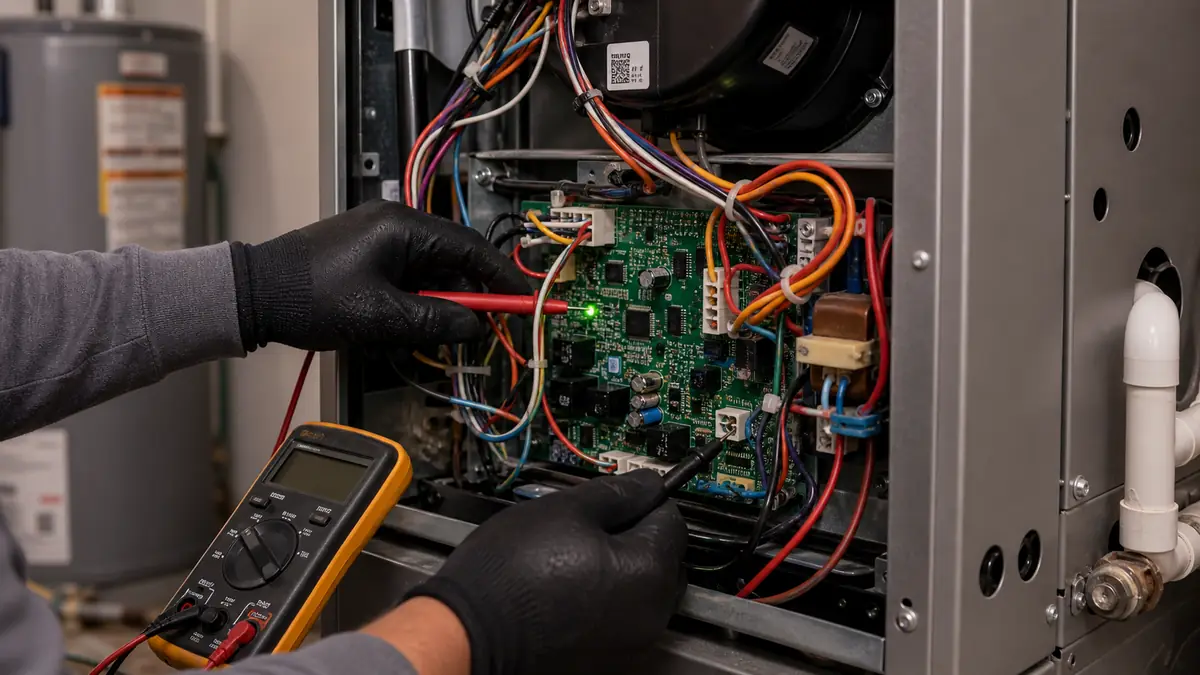
The center of a code 34 diagnosis is one measurement most homeowners never see: flame-sense current. We break the flame-sensor circuit and put a meter in series, in microamp mode, then fire the burner and read the current while the flame is established. A clean, healthy Carrier sensor reads several microamps, often 4 to 8; the control wants more than roughly 1 to 2 to call it a proven flame. A reading that sits just above the threshold and sags as the burner runs explains a furnace that lights, runs a moment, then drops on code 34. From that number we branch. If the current is low and the rod looks oxidized, we clean it with a non-abrasive pad and re-read; a jump back into range confirms it. If a clean does not recover the signal, we check the sensor ground and the sensor wire for corrosion, then inspect the burner flame, because a lazy yellow or lifting flame from low gas pressure does not envelop the rod well enough to conduct. We verify manifold pressure on a manometer at that point. Replacing the sensor is the fix when the rod is pitted or cracked. We do not call it done until the re-read flame current is solidly in range across a full cycle.
What can I safely check myself versus call a pro?
The safe homeowner check on a code 34 is short. Confirm the furnace switch and gas are on, then cycle power once and watch a cycle: a furnace that lights and quickly drops out is consistent with the flame-sensor story, which is useful for us to hear. That is the limit. The flame sensor sits inside the live burner compartment, the microamp reading requires breaking into the sensor circuit safely, and cleaning the rod means doing it with the gas off and reseating it at the correct depth and angle. Sanding a sensor too aggressively, bending the rod, or reinstalling it touching the burner makes the reading worse, and doing any of it with gas present is unsafe. Do not jumper the flame sensor or the gas valve to force the furnace to run, since that defeats the exact safety the code is enforcing. If a single power cycle does not bring it back, the microamp reading, the ground check, and the gas-pressure verification are tech work. If you ever smell gas, leave the gas off and call from outside.
What does fixing a code 34 cost in Encino, and when is it urgent?
Code 34 is one of the friendlier Carrier faults on cost, because the usual repair is a flame-sensor clean or replacement at roughly $150 to $350, and that resolves the large majority of calls. The diagnostic visit runs about $89 to $200, often near $139, credited toward an approved repair. The price climbs only if the readings point past the sensor: a gas-pressure correction, a control board around $400 to $900, or a gas valve from $300 to $700, all of which are the minority on a 34. On urgency, code 34 is the furnace failing safe, so a single occurrence is no hazard; you simply have intermittent or no heat. Treat it as urgent if you smell gas, if the furnace cycles on and off chasing the flame for long stretches, or if it has escalated into repeated code 14 lockouts, which means the sensor has gotten worse. Most Encino code 34 repairs are handled same-day because the part rides on the truck. For the full code reference, see our Carrier fault codes guide, and for the hands-on repair, our furnace repair page.
Common questions about Carrier code 34 in Encino
What does Carrier code 34 mean?
Code 34 is an ignition-proving failure. The burner did light, but the flame sensor stopped reading a steady flame within the proving window, so the control shut the gas valve and flagged 34. Unlike a furnace that never lights, a code 34 furnace catches fire and then loses the signal, which points almost always at the flame sensor or its grounding rather than the igniter.
Is code 34 the same as code 14 on a Carrier?
No, and the difference guides the fix. Code 14 is a hard lockout after the furnace never proved flame across all its tries. Code 34 is the proving step itself failing on a cycle: flame lit but was not confirmed. A furnace often throws 34 first on a weak flame sensor, then escalates to a 14 lockout if the sensor keeps falling short. Both usually trace to the same dirty or weak sensor.
Will cleaning the flame sensor fix code 34?
Often, yes. A flame sensor coated in oxidation or soot reads too few microamps, and a careful clean restores the signal on most code 34 calls. We do not stop at the clean, though: we re-read flame current to confirm it is back in range, check the sensor ground, and inspect the burner flame, because a low reading can also mean a misaligned sensor or a marginal gas supply, not just a dirty rod.
How fast can you clear a code 34 in Encino?
Most code 34 calls are same-day or next-day. The common fix, a flame-sensor clean or replacement at roughly $150 to $350, uses a part we keep on the truck, so we usually diagnose and repair in one Encino visit. Gas-side faults take longer because they involve pressure testing and sometimes a valve, but those are the minority on a code 34.