High HVAC Energy Bills in Encino, CA
Straight talk: High HVAC bills in Encino, CA usually trace to leaky ducts, low refrigerant, a dirty coil, or an aging low-SEER2 system working overtime through a long Zone 9 summer. Encino Carrier HVAC measures the real cause across 91316 and 91436, so call (213) 755-3565 or book online.
Service snapshot
- High-bill diagnosis on Carrier systems across Encino (91316, 91436).
- Top causes: leaky ducts, low R-410A charge, dirty coil, low-SEER2 equipment, oversizing.
- Encino runs 50 to 70 days a year above 90 F, so small inefficiencies compound.
- Duct sealing often the best dollar-per-savings fix before equipment.
- Smaller split ACs in the Southwest must meet 14.3 SEER2 / 11.7 EER2.
- No federal 25C credit after 12/31/2025; confirm LADWP and SCE rebate status.
- Hours: Mon-Fri 7am-7pm, Sat 8am-4pm; emergency line after hours.
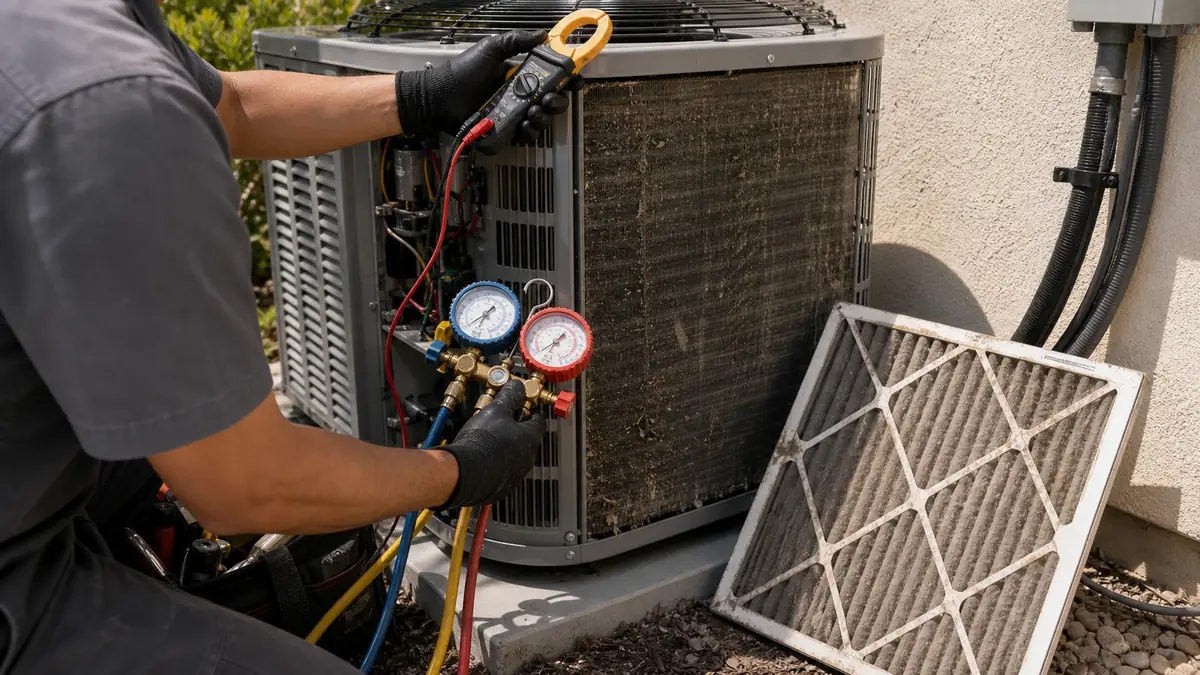
What drives a high HVAC bill in Encino?
Encino's long cooling season magnifies every inefficiency. The four usual suspects are duct leakage dumping cold air into a 130 F attic, a low refrigerant charge from a slow leak, a dirty evaporator or condenser coil raising head pressure, and simply an old low-SEER2 system that runs flat-out. Oversized equipment is a fifth cause: it short-cycles, never settling into an efficient steady state. We measure rather than guess so you fix the real driver.
| Cause | First check | Fix cost lane |
|---|---|---|
| Leaky ducts | Duct leakage / static pressure test | $800 - $3,000 |
| Low refrigerant charge | Superheat/subcool, leak search | $225 - $1,500 |
| Dirty coil | Coil cleaning, head-pressure check | $150 - $500 |
| Old low-SEER2 unit | Compare to 14.3+ SEER2 upgrade | $6,000 - $16,000 |
Which fixes pay back fastest?
In Encino, duct sealing and a coil cleaning usually return the most per dollar, because they cut runtime without a new system. Correcting a low charge restores capacity so the unit stops running all day. Replacing a 12-plus-year-old low-SEER2 condenser with a modern Carrier Performance or Infinity unit is the bigger spend, but the efficiency gain over a long cooling season is real. Our duct sealing page and repair-or-replace guide cover the trade-offs.
How do we measure where the money is going?
Guessing is how homeowners overspend, so we measure. We read total external static pressure to flag duct or airflow restriction, then check refrigerant superheat and subcool to confirm the charge is correct rather than assuming. We inspect the evaporator and condenser coils for the dust film that drives up head pressure and clamp the compressor and condenser-fan amperage against the nameplate. On a communicating Infinity system we pull stored runtime and staging data off the touchscreen, which shows whether the unit is short-cycling or running flat-out all day. A duct-leakage check finishes the picture, because in a ranch-era Encino attic the duct losses are usually the single biggest line item.
A worked example: what leaky ducts cost over a summer
Picture a 1962 single-story near Encino Village with a 3-ton condenser and original ducts leaking about 25 percent of their air into a 130 F attic. Effectively the system delivers closer to 2.25 tons into the rooms, so it runs roughly a third longer to hold setpoint through a stretch of 95 F afternoons. If that unit would otherwise run six hours a day at about 3.5 kW, the leakage adds close to two hours of daily runtime, near 7 kWh, across the 50 to 70 days a year Encino tops 90 F. Sealing the accessible duct joints and the return plenum, typically an $800 to $3,000 job, claws back most of that runtime and usually pays for itself faster than any equipment swap.
What about rebates and incentives?
Run the rebate math with caution. The federal 25C heat-pump tax credit was repealed as of December 31, 2025, so none of it reaches 2026 work. LADWP, SCE, and SoCalGas have each run HVAC rebates, yet a number of California programs were reported fully reserved or paused early in 2026. We confirm the live amounts and the eligibility before any figure goes into a quote, which keeps you from planning around money that has already dried up.
Common questions about high HVAC bills in Encino
Why did my Encino summer bill jump even though nothing broke?
Gradual creep usually means a dirty coil, low refrigerant, or worsening duct leaks, all of which make your Carrier system run longer for the same cooling. A 1-degree drop in delivered cold across a 95 F Encino afternoon adds a lot of runtime over a month. We measure charge and airflow to find which one it is.
Is my old single-stage condenser the reason for high bills?
It can be a big part. An older single-stage unit at low SEER2 runs flat-out every cycle, while a modern variable-speed Carrier Infinity modulates and sips power at part load. On a long Encino cooling season the efficiency gap shows up clearly on the SCE bill.
Will sealing ducts actually lower my bill?
Yes, often noticeably. Ranch-era Encino ducts can leak 20 to 30 percent of conditioned air into a 130 F attic. Sealing those leaks means more cold reaches the rooms per kilowatt, so the system cycles off sooner. It is usually the best dollar-per-savings fix before replacing equipment.
Do thermostats and rebates help with the bill?
To a point. A smart schedule pares back runtime while the house is empty, and utility rebates can take the edge off a high-efficiency upgrade. Go in skeptical on the rebate side, though: the federal 25C credit lapsed after 12/31/2025, and a few California programs were reported paused in early 2026, so confirm the current amounts.
How much can a low refrigerant charge add to my Encino bill?
A surprising amount. A system running even 15 percent low on R-410A loses capacity and runs far longer for the same cooling, and a badly undercharged unit can use 20 percent more energy while still freezing the coil. On a 3-ton condenser pulling roughly 3.5 kW, the extra runtime across a 50-to-70-day Encino heat stretch shows up clearly on the SCE bill.
Does a variable-speed Carrier Infinity really save that much over a single-stage?
Over a long Zone 9 season, yes. A single-stage Comfort 16 runs full-tilt every cycle, while an Infinity 24VNA6 with Greenspeed modulates down to about 25 percent capacity and sips power at part load, which is where Encino spends most spring and fall hours. The gap is widest on mild days and on oversized systems that would otherwise short-cycle.