Carrier AC Making Noise in Encino, CA
Straight talk: A noisy Carrier AC in Encino, CA tells you a lot: a buzz usually means a failed capacitor, grinding a bad fan-motor bearing, and rapid clicking an ignition fault. Encino Carrier HVAC diagnoses the sound across 91316 and 91436, so call (213) 755-3565 or book online before a heat wave.
Service snapshot
- Noise diagnosis on Carrier systems across Encino (91316, 91436).
- Buzz/hum: failed run capacitor or contactor chatter.
- Grinding/screech: condenser fan motor bearing or blower wheel.
- Rapid clicking + no heat: igniter or flame-sensor lockout (code 14/34).
- Rattle: loose panel, debris, worn grommet.
- Capacitor/contactor fixes $150 - $450; fan motor $300 - $900.
- Hours: Mon-Fri 7am-7pm, Sat 8am-4pm; emergency line after hours.
What does each sound mean?
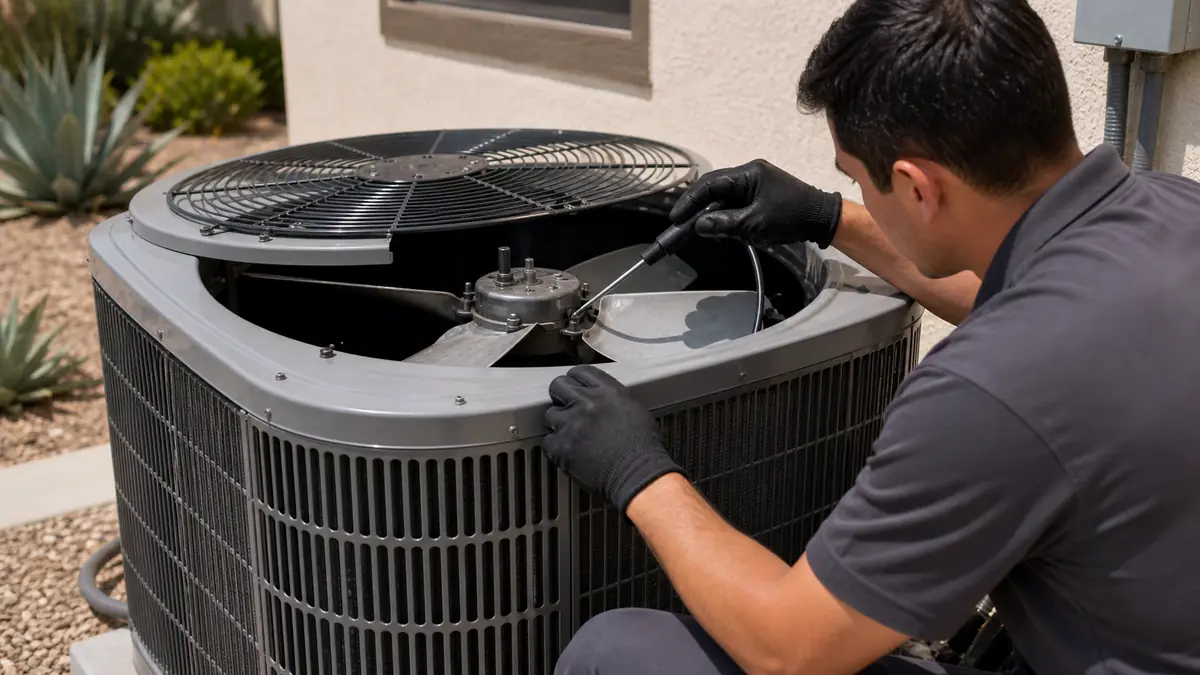
The noise is a clue to the failing part. A steady electrical buzz with a dead fan is almost always a run capacitor that has lost capacitance, common after a string of 90 F-plus Encino days bake it. A rhythmic chatter at startup is a worn contactor. Grinding or screeching from the outdoor unit is a failing condenser fan motor bearing. From the furnace, rapid clicking with no heat is the ignition train failing to prove flame.
| Sound | Likely cause / first check | Cost lane |
|---|---|---|
| Electrical buzz, fan won't start | Failed run capacitor | $150 - $450 |
| Chatter at startup | Pitted contactor | $150 - $450 |
| Grinding / screeching outside | Condenser fan motor bearing | $300 - $900 |
| Rapid clicking, no heat | Igniter / flame sensor (code 14/34) | $150 - $650 |
| Rattle / vibration | Loose panel, debris, grommet | $89 - $250 |
When should I shut the system off?
Kill power at the disconnect for grinding, screeching, or a loud metallic bang. Those point at a mechanical failure that gets worse and more expensive the longer it runs. A buzz or a single click is less urgent, but still worth a same-week look before an Encino heat wave turns it into a no-cool emergency. The repair side lives on our heat pump repair page and furnace repair page.
How do we track a noise to its source?
We localize the sound before pulling anything apart. At the condenser we cut power at the disconnect, spin the fan by hand to feel for a rough or notchy bearing, and rock the motor shaft for end play. With power restored we clamp the compressor and fan amperage and read the run capacitor in microfarads against its rating; a 45/5 dual-run cap reading 30 is a confirmed failure even if the unit limps along. A chatter at the moment the contactor pulls in points at pitted contacts. Inside, a screech that rises with blower speed is the indoor ECM bearing, while a rattle that comes and goes is usually a loose panel or debris. From the furnace we scope the burners and watch the ignition sequence through the sight glass to separate a normal lighting click from a failing igniter.
What can I safely check, and what needs a pro?
Safe homeowner checks: kill power at the disconnect and look for obvious debris (a stick, a fallen branch, leaves) lodged in the condenser fan, and tighten any loose access-panel screws you can reach. That clears a surprising number of rattles. Do not spin a stalled fan with a stick to get it going, do not open the electrical compartment, and do not run a grinding unit hoping it settles. The run capacitor stores a dangerous charge even with power off, the contactor switches line voltage, and a failing bearing thrown at speed can damage the coil. Grinding, screeching, a metallic bang, or any gas smell means power off and a same-week call.
What do these noise repairs cost in Encino?
Most noise fixes are mid-range, not catastrophic. A failed run capacitor or a pitted contactor runs roughly $150 to $450 installed, and these are the most common Encino summer failures. A condenser fan motor with a bad bearing is about $300 to $900 depending on the motor. A furnace igniter or flame sensor that is causing clicking or a delayed-ignition boom lands around $150 to $650. A loose-panel or debris rattle is often handled within the $89 to $200 diagnostic visit. The expensive outliers are a noisy compressor or a variable-speed ECM blower module, which is why we confirm the part with a meter before quoting.
Could the noise be a refrigerant problem?
Sometimes. A hissing or gurgling near the line set can indicate a refrigerant leak or a metering-device issue, which also shows as weak cooling and iced coils. We leak-search and read superheat and subcool rather than just topping off refrigerant, because chasing a leak with a recharge only delays the real fix. See our water-leak page for the related condensate side.
Common questions about a noisy Carrier AC in Encino
My Carrier condenser buzzes but the fan won't spin. What is it?
A buzz with a stalled fan is the classic failed run capacitor. The motor has voltage but not the phase shift it needs to start, so it hums. Do not spin it with a stick; that masks the problem and risks the motor. We confirm with a microfarad reading and replace the capacitor.
There is a loud grinding from the outdoor unit. Should I shut it off?
Yes, turn it off at the disconnect. Grinding usually means a failing condenser fan motor bearing or a fan blade hitting something. Running it risks the motor and the blade. Shutting it down and calling us prevents a small fix from becoming a fan-and-motor replacement.
What is the clicking from my Carrier furnace before it heats?
A few clicks as the furnace lights is normal: that is the igniter and gas valve sequencing. Rapid repeated clicking with no heat usually means a failed igniter or a flame-sensor lockout, often code 14 or 34 on a 59-series board. That one needs a tech.
Is a rattling sound serious on a Carrier system?
Often not, but worth checking. Rattles are commonly loose panel screws, debris in the condenser, or a worn fan grommet. Left alone, a vibration can loosen refrigerant-line connections over time, so we tighten and inspect rather than ignore it.
My Greenspeed Infinity compressor makes a low growl at startup. Is that bad?
Usually not. A variable-speed Greenspeed compressor on an Infinity 24VNA6 or 25VNA4 ramps up slowly and can produce a soft growl or warble as it modulates, which a single-stage owner is not used to hearing. A loud metallic knock or a hard clatter is different and worth a look, but a gentle low-speed hum is normal modulation.
Why does my furnace boom when it lights?
A delayed-ignition boom means gas pooled in the burners before igniting, often from a weak igniter, a partially blocked burner, or a dirty flame sensor that delays proving. It is hard on the heat exchanger and worth fixing promptly. On a 59-series board this often pairs with a code 34 ignition-proving fault, so we inspect the burners and igniter rather than just resetting.