Carrier HVAC Maintenance Plans in Encino
Straight talk: Encino Carrier HVAC runs seasonal maintenance plans across Encino, CA, from Lake Encino to the 91436 hills, with spring AC and fall furnace tune-ups that catch weak capacitors, low charge, and dirty coils before a 95 F day strands you; call us at (213) 755-3565 or book online. Plan members also get priority scheduling during no-cool heat spells.
Service snapshot
- Seasonal Carrier tune-ups across Encino (91316, 91436) and the named tracts.
- Spring cooling visit and fall heating visit, scheduled around Encino's heat calendar.
- Checks: capacitor, contactor, refrigerant charge, coil cleaning, static pressure, igniter, flame sensor.
- Documented maintenance supports Carrier equipment warranty expectations.
- Plan members get priority scheduling during no-cool heat spells.
- Typical tune-up visit and plan pricing quoted on booking.
- Hours: Mon-Fri 7am-7pm, Sat 8am-4pm; emergency line after hours.
Why does maintenance matter more in Encino?
Encino's Zone 9 heat runs condensers hard for 50 to 70 days a year above 90 F, and a lot of equipment sits next to a 130 F attic or a sun-baked side yard south of the Boulevard. That environment ages capacitors, bakes contactor contacts, and lets coil dirt drive up head pressure. A spring tune-up catches the weak capacitor before it strands you on the hottest afternoon, when emergency calls stack up and you wait in line.
What happens during a tune-up visit, step by step?
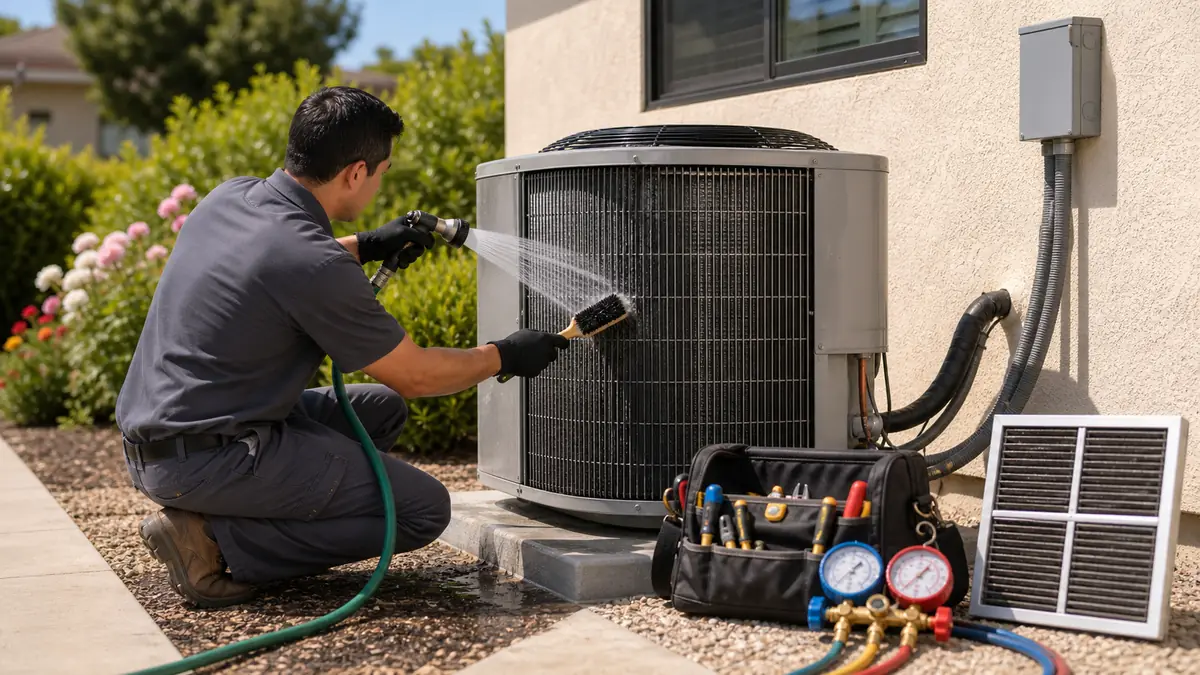
A spring cooling visit walks the same checks an Encino no-cool diagnosis would, except we run them before a part has actually quit on you. We read the dual-run capacitor against its nameplate microfarads and flag any cap that has drifted, inspect the contactor for pitting, then clamp the condenser fan and compressor amp draw. We put gauges on and read superheat and subcooling to confirm the R-410A charge and catch a slow leak early, wash the condenser coil so head pressure stays down in the 130 F side yard, and measure static pressure and airflow to find a clogging filter or a starved return. The fall heating visit walks the ignition train, checking the hot-surface igniter, the flame-sensor microamp signal, the inducer, and the pressure switch, and we pull any stored 59-series codes. On a communicating Infinity system we read the stored fault history off the touchscreen at every visit.
What is on the checklist?
Our visit is a real inspection of the parts that actually fail. The table shows the core checks and what each one prevents.
| Check | What it catches | Season |
|---|---|---|
| Capacitor microfarads, contactor | No-start failures in peak heat | Spring |
| Refrigerant superheat/subcool, coil | Low charge, leaks, high head pressure | Spring |
| Condenser fan and compressor amp draw | Failing motor or laboring compressor | Spring |
| Static pressure, filter, blower | Airflow restriction, iced coils (code 44) | Both |
| Igniter, flame sensor, inducer | 59-series no-heat lockouts (14/34/31) | Fall |
| Condensate drain and float switch | Water shutdowns and overflow | Both |
| Stored fault codes on Infinity | Early board or comm issues (178/179) | Both |
Which Carrier systems does a plan cover?
A plan fits any Carrier system in an Encino home, and the visit adapts to the tier. A single-stage Comfort condenser and a 58-series 80-percent furnace get the core electrical, charge, and ignition checks. A two-stage Performance system adds the staging and the second-stage verification. A variable-speed Greenspeed Infinity system, a 25VNA4 or 27VNA3 on an Infinity System Control, gets the full communicating diagnostic: we read the stored fault log, confirm the inverter is modulating, and check the A-B-C-D bus for the early signs of a 178 or 179 fault. Zoned estate systems with multiple air handlers count as multiple systems, since each gets its own full inspection.
How does this protect my warranty and budget?
Carrier equipment warranties generally expect documented routine maintenance, so a plan keeps that paper trail in case you ever file a part claim through a Carrier factory-authorized dealer. Just as important, catching a dirty coil or a failing capacitor early avoids the cascade where high head pressure shortens a compressor's life. For the bigger repair-or-replace decisions, see our repair-or-replace guide.
Why does the Encino climate calendar drive the schedule?
Timing is half the value of a plan in this microclimate. Encino sits in Title-24 Climate Zone 9 against the Santa Monica Mountains, where hot, still afternoons stack up 50 to 70 days a year above 90 F and Santa Ana stretches push past 100 F. That heat is exactly when a marginal capacitor finally quits and when the emergency queue is longest, so a spring visit in March or April clears the cooling side before the first real heat wave. The fall visit in October or November catches the ignition train before the cold mornings off the hills ask the 59-series furnace to run. Booking those windows ahead of the rush is the difference between a planned tune-up and a no-cool wait in line.
Location on the lot matters too. A lot of Encino condensers sit in a sun-baked side yard or right next to a 130 F attic, so coil dirt and high head pressure build faster than the brochure life would suggest. A rebuilt estate south of the Boulevard may run two or three Carrier systems that each need their own seasonal attention. We tune the visit schedule to the home, not a generic national calendar.
Common questions about Encino maintenance plans
When should I schedule a tune-up in Encino?
Spring, before the first real heat wave, for the AC side, and fall for the furnace. A spring visit catches a weak capacitor or low refrigerant before a 95 F Encino afternoon turns it into a no-cool emergency that costs more and waits in line behind everyone else.
What does a Carrier tune-up actually check?
On the cooling side we read capacitor microfarads, contactor condition, refrigerant superheat and subcool, condenser fan amp draw, coil cleanliness, and static pressure. On the heating side we check the igniter, flame sensor signal, inducer, and any stored 59-series codes. It is a real inspection, not a quick filter swap.
Does maintenance keep my Carrier warranty valid?
Carrier's equipment warranties generally expect documented routine maintenance. A plan gives you that paper trail. For any in-warranty part claim, you still go through a Carrier factory-authorized dealer; we keep the maintenance records that support the claim.
Is a plan worth it on a newer system?
Yes, especially in Encino heat. Even a two-year-old condenser benefits from a coil cleaning and a charge check, because a dirty coil in a 130 F attic-adjacent location quietly raises head pressure and shortens compressor life. Catching it early is far cheaper than a compressor.
What does priority scheduling actually get me in a heat wave?
When a 100 F Santa Ana stretch hits Encino and no-cool calls stack up, plan members move to the front of the queue and get same-day or next-day service instead of waiting days. That matters most south of the Boulevard and on hillside 91436 lots where a dead condenser in peak heat is a real problem, not an inconvenience.
How long does a tune-up visit take?
Plan on about an hour per system for a thorough visit. A single condenser-and-furnace combo on a mid-century ranch is quick; a zoned multi-system estate south of the Boulevard takes longer because each Carrier system, its coil, and its zone dampers get checked. We are reading real measurements, not just rinsing a coil and leaving.
Will a plan really save me money, or is it just insurance?
Both, and the math favors it in Zone 9. A $25 capacitor caught in spring beats a $400-plus emergency call on the hottest afternoon, and a clean coil keeps head pressure down so the compressor, the most expensive part on the unit, lasts its full life. The plan pays for itself the first time it heads off a peak-season breakdown.